Background
Can AI really rebuild any app?
A similar-looking interface can be impressive. A useful, working application takes more to establish.
An AI rebuilds a familiar app, and expensive software suddenly seems unnecessary. Some demonstrations create that impression. The important question is what was actually rebuilt.
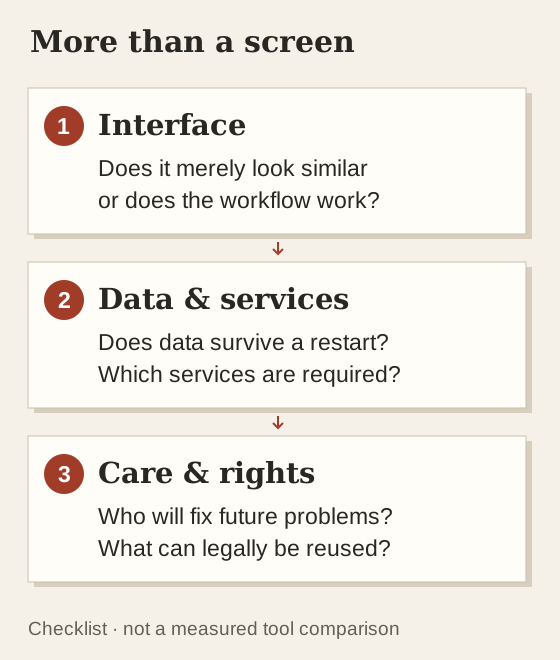
As a user, you first see buttons, input fields and results. Behind them may be data storage, error handling, access controls or a service running elsewhere. A similar-looking screen does not establish that those parts work.
What a tool such as REA contributes
REA is an open-source (MIT-licensed) analysis tool for coding assistants. It examines software and returns findings with evidence. An assistant can use those findings to explain behaviour or develop an implementation. For native programs, its documentation lists pseudocode and additional analysis tools. This is not automatic access to the original source code or a promise to reproduce every application in full. REA · Original repository and documentation
A useful question is therefore: “Which specific function can I understand and implement with this?” That is a smaller, testable task. Simply asking for a copy leaves the definition of success unresolved.
Four questions for any demo
What works? Are we seeing a screen, one workflow or the entire promised task? In a notes app, a first workflow might be creating, editing and reopening a note.
Does the data survive? Close the application and start it again. Is the note still there? What happens with an empty input or an unusually long title? Small checks like these tell you more than an attractive screenshot.
What sits beyond the screen? Sync, accounts and payment features may depend on additional services. Ask what happens locally and what needs a remote server. The interface alone cannot answer that.
Who maintains the result? Even a small personal tool needs someone to fix problems and check future changes. A working first version does not settle that responsibility.
An idea is different from someone else’s code
In Germany, copyright law distinguishes a program’s ideas and principles from its protected expression. Under section 69d(3), people entitled to use a copy of a program may observe, study or test how it works to identify its underlying ideas and principles. This applies only through acts such as loading or running it that they are already entitled to perform. This does not create a general permission to copy someone else’s code or protected content. UrhG § 69a · UrhG § 69d
Decompilation – translating program code back into a more readable form – is a separate step. Section 69e permits certain acts under narrow conditions when they are indispensable to obtain information needed for an independently created program to work with other programs. Information obtained this way must not be used for other purposes or for a program with substantially similar expression. Wanting to make a copy does not itself provide permission. Whether a particular analysis is allowed depends on factors including rights, permissions and purpose. This is an overview of German law, not legal advice. UrhG § 69e
Describe your own task first
You may not need a copy of a large product. Perhaps you only need a small tracker for borrowed books. Describe that need in your own words. This gives the AI an objective you can check.
“I want to keep a local record of books I have borrowed. Each entry needs a title, a return date and a returned checkbox. Start by describing the smallest useful workflow. Explain where the data will be stored. Use original wording and design. Do not build anything until I have read the plan.”
You could then use made-up entries to check whether you can create, edit and delete records and find them again after restarting. This is a proposed exercise, not a product we have tested.
We have not installed or practically tested REA for this article. Our explanation draws on the project documentation and the linked legal texts. A convincing result would be a small application whose limits you understand – and whose main task actually works.
Sources
- REA · Original repository and documentation
Primary source; checked 18 October 2026.
- UrhG § 69a
Primary source; checked 18 October 2026.
- UrhG § 69d
Primary source; checked 18 October 2026.
- UrhG § 69e
Primary source; checked 18 October 2026.