Everyday life
AI influencers: a face is not evidence
A likeable profile can be entirely fictional. What matters is who is behind it and what you can verify.
Someone talks about their day, recommends products and looks straight into the camera. It feels personal. Yet the account may be showing an artificially generated character.
A fictional character is not automatically a scam. An openly presented art project can be entertaining. The problem begins when a character claims experiences or an identity that you are expected to rely on.
Look beyond hands and skin
An odd finger may be a reason to look more closely. Smooth skin does not prove an image is fake, and a flawless face does not prove the person is real. Hunting for visual mistakes can distract from a more useful question: why should I trust this particular claim?
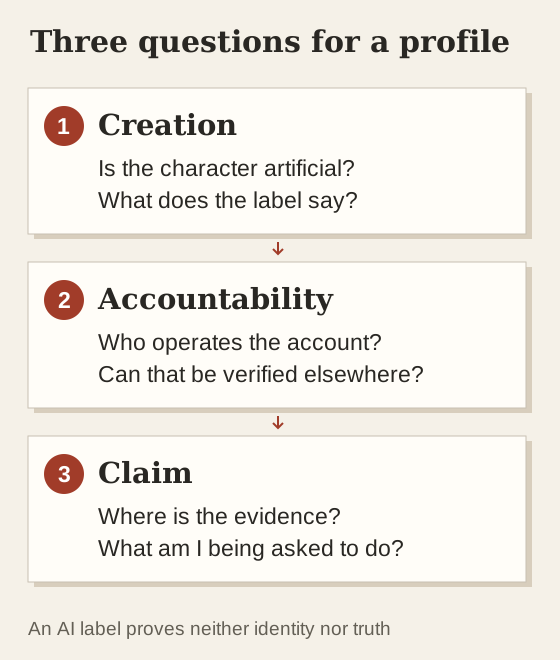
Start with the profile and description. Is the character identified as artificial? Is a person, company or studio named as its operator? Can you verify anything beyond this one account? A reverse image search may reveal earlier uses of a picture, but finding no match does not establish authenticity.
A label describes production, not truth
In 2024, Meta described labels based on technical signals or users’ disclosures. It also acknowledges detection gaps: not every AI-made item can be reliably marked. A missing label is therefore not proof that a picture is genuine. Meta · AI labels and their limits
TikTok says it requires labels for realistic AI-generated content. Such labels help explain how content was made. They do not establish whether a depicted person consented or whether a recommendation is true. TikTok · Transparency and realistic AI content
Check the recommendation separately
Suppose a character enthusiastically recommends a backpack. Do not only ask whether the character is artificial. Ask where the claims about the product come from. Is advertising disclosed? Can you find dimensions, materials and return conditions from the actual seller? A convincing face does not replace those checks.
The same applies to apparently personal messages. A familiar face is not sufficient reason to send money or private photos. If someone claims to be a person you know, check through an independent contact method you already trust.
If your own face appears
First save the exact link, account name, time and a screenshot. Avoid reposting the material publicly as a warning; that may spread it further. Report the specific content and, where appropriate, the impersonating account through the platform’s relevant reporting route.
Describe what is happening: “This account is impersonating me” or “My image is being used without my permission.” You do not first need to become an AI forensics expert. Keep the response and any case number.
In the EU, the Digital Services Act provides for reporting procedures for illegal content. For certain moderation decisions, online platforms subject to the relevant provision must also offer an internal complaints system. A report does not guarantee immediate removal. EU · Digital Services Act, Articles 16 and 20
In Germany, section 22 of the Kunsturhebergesetz generally requires consent before a person’s image is distributed or publicly displayed; section 23 sets out exceptions and their limits. Applying those rules to a particular synthetic depiction requires individual assessment. Seek appropriate legal help with reputational harm, threats or intimate fakes. KunstUrhG § 22 · KunstUrhG § 23
Less public material, not complete control
Check which photos and profile details are publicly visible. Remove unnecessary information and choose who can see new posts. This limits open availability, but cannot prevent copying by people who have access.
A useful habit: Treat a familiar-looking face as one part of a post. Check who is behind it, the specific claim and the action you are being encouraged to take.
Sources
- Meta · AI labels and their limits
Primary source; checked 18 October 2026.
- TikTok · Transparency and realistic AI content
Primary source; checked 18 October 2026.
- EU · Digital Services Act, Articles 16 and 20
Primary source; checked 18 October 2026.
- KunstUrhG § 22
Primary source; checked 18 October 2026.
- KunstUrhG § 23
Primary source; checked 18 October 2026.