Hands-on
When your child talks to AI: five questions for home
At a glance
Ask your child to show you where they come across AI, then talk through five questions. Check important answers against an independent source. Look at the age requirements and safety settings of the specific service.
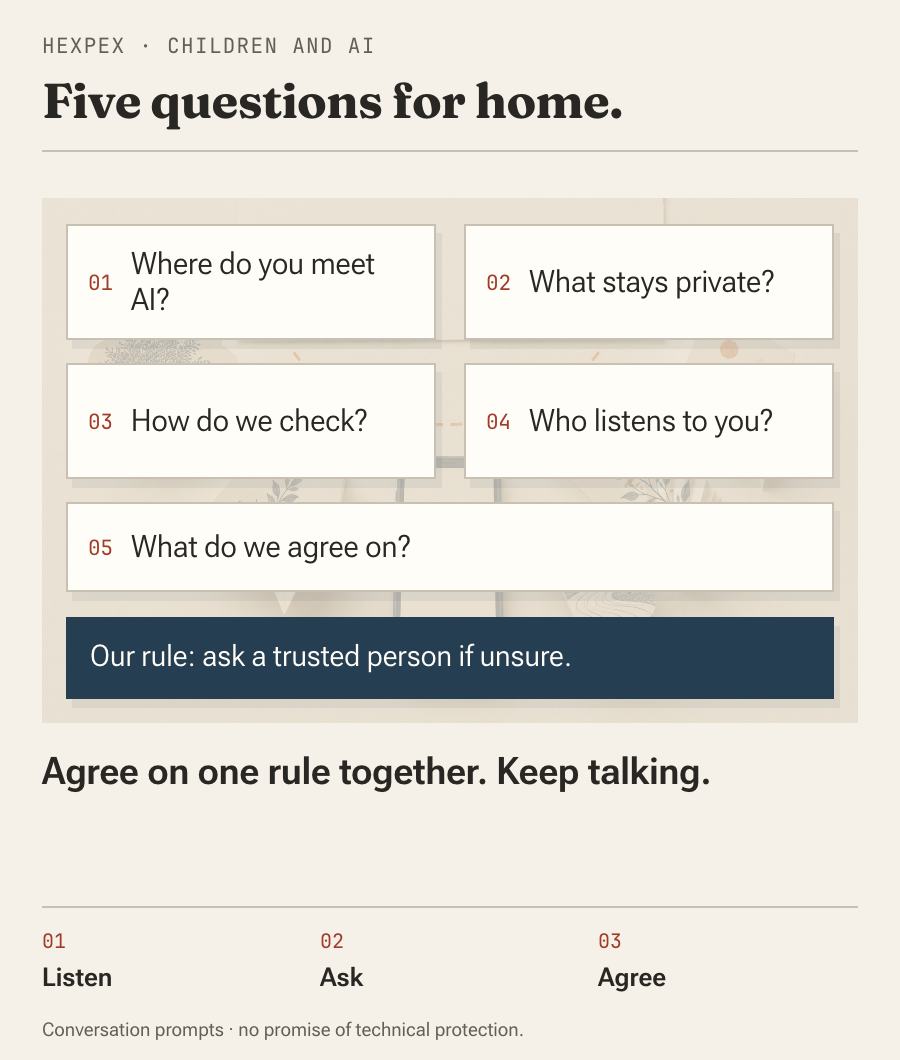
Your child has asked an AI something. That can be a good moment to talk together about answers, private information and trust.
You don't need to know every app for this. Start by asking your child to show you where they come across AI. A calm conversation can begin with the five questions below.
Where do you come across AI?
While learning, in an app or when chatting? Listen first to what your child uses it for. If it makes sense, look at the service together.
What stays private?
Talk about which personal details and private pictures you don't want to share in a chat.
How do we check an answer?
An answer can sound convincing and still be wrong. For important statements, look for a suitable independent source.
Source: klicksafe (24 April 2026, German) · SCHAU HIN! (23 September 2025, German)
Who really listens to you?
A chatbot can answer kindly and seem like a friend. Think together about which trusted person your child can turn to with worries.
Source: klicksafe (24 April 2026, German) · SCHAU HIN! (23 September 2025, German)
What do we agree on?
Look at the age requirements and safety settings of the specific service. Write down what you try out together and when you get help.

A small exercise for home
Pick a harmless question, for example why leaves change colour in autumn. An adult can show the answer in a suitable, age-appropriate service; your child doesn't need their own account for this.
Then compare one specific statement with a children's encyclopedia. Asking “How sure are you?” doesn't replace that comparison: the answer to it is not a fact check.
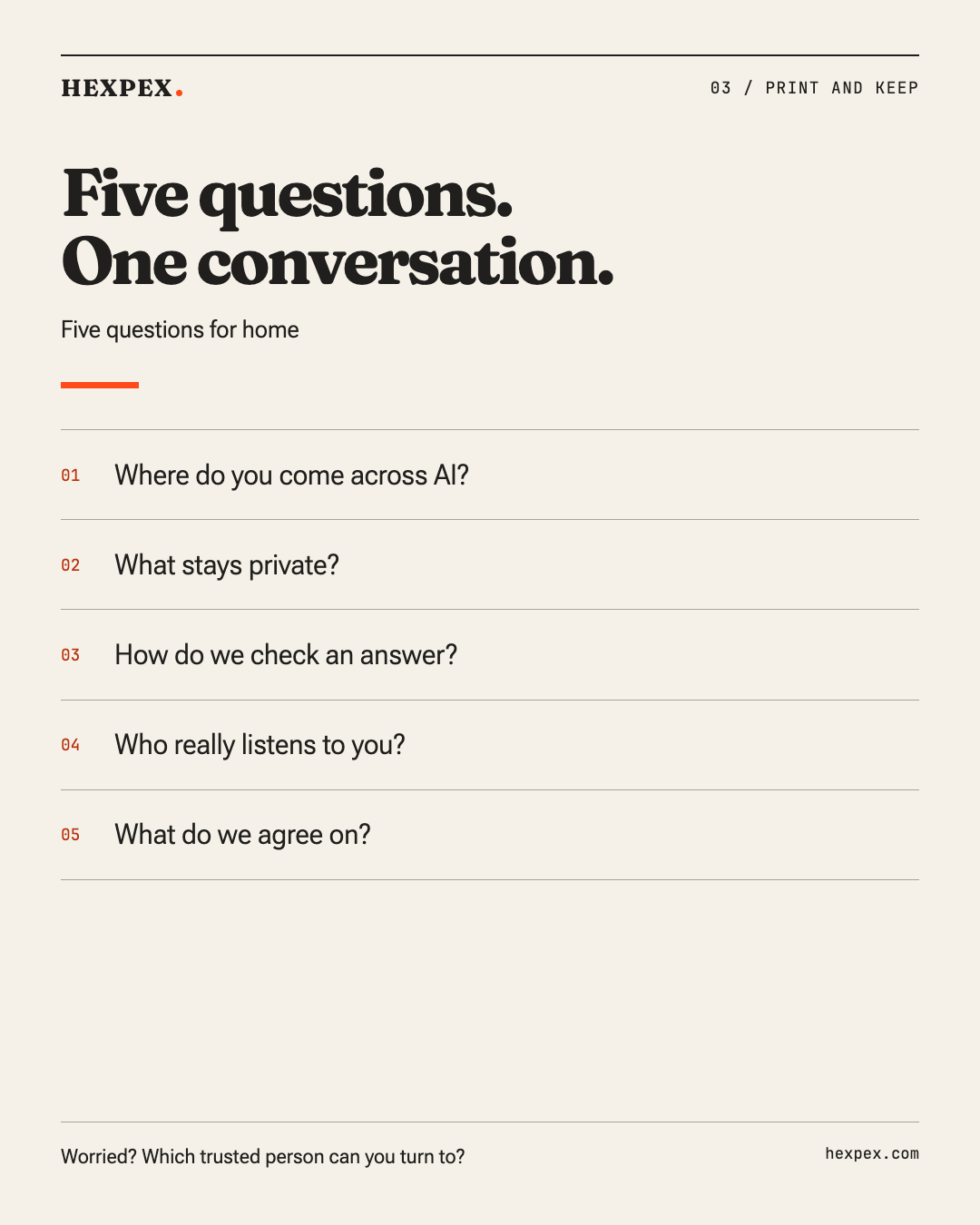
HEXPEX03 / Print and keep
Five questions.
One conversation.
Five questions for home
Where do you come across AI?
What stays private?
How do we check an answer?
Who really listens to you?
What do we agree on?
Source: klicksafe (24 April 2026, German) · SCHAU HIN! (23 September 2025, German)
Sources
- klicksafe (24 April 2026, German)
Media education guidance: exploring together, limits, personal data, real-life contacts and youth protection settings.
- SCHAU HIN! (23 September 2025, German)
Accompanying text for a digital parents' evening: parental guidance, critical questioning, friendships that only seem real.