Practice
Learning with AI: Think first, then ask
At a glance
Let AI ask questions and offer hints. Afterwards, check what you can explain without the chat. A prompt can suggest this routine, but cannot reliably enforce it.
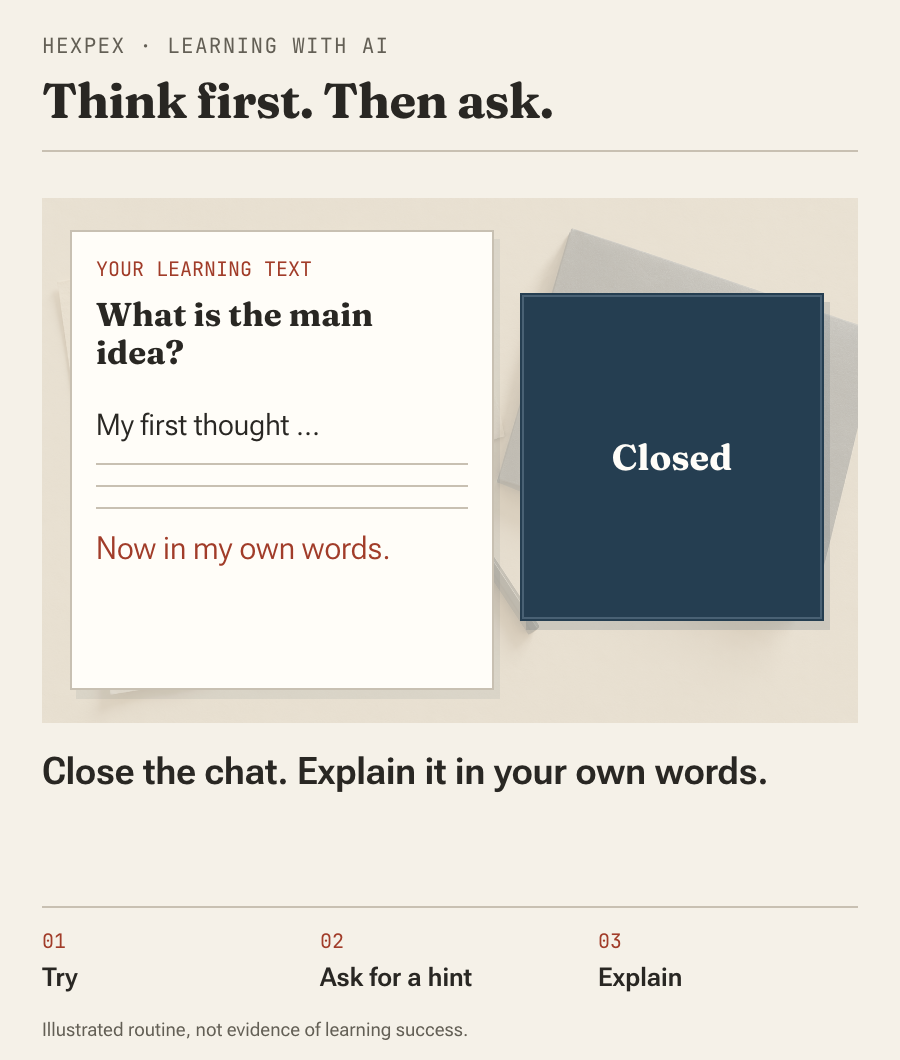
The AI has solved the problem. Have you understood it too?
When you are learning, those are different things. A finished explanation can seem reassuringly clear. Whether you can reproduce the reasoning becomes apparent when the answer is no longer in front of you. You can use a chat differently: as a partner that asks questions rather than working everything out immediately.
A correct answer is not yet evidence of learning
Nearly 1,000 students practised mathematics in an experiment at one Turkish school. AI help improved practice results. In the test without AI, however, the ordinary-helper group performed below the comparison group. A specially configured tutor avoided that disadvantage but offered no statistically established test advantage. The often-quoted 127 per cent improvement concerns practice with the tutor.
Source: Bastani et al. (2025), PNAS
Why a good tutor needs more than one sentence
A second study, with 194 students included in the analysis of a Harvard physics course, found higher immediate learning gains with a custom-built AI tutor than in the active-learning classroom sessions examined. It covered two lessons.
This system guided students through problem parts and received prepared solutions and subject-specific guidance. An ordinary chat told “Be my tutor” is not equivalent. The study does not establish long-term benefits across arbitrary subjects.
Source: Bastani et al. (2025), PNAS · Kestin et al. (2025), Scientific Reports
Try a small learning session
Choose a short passage from learning material you can check. Remove personal information. Ask the AI to quiz you one question at a time, and attempt the first answer yourself.
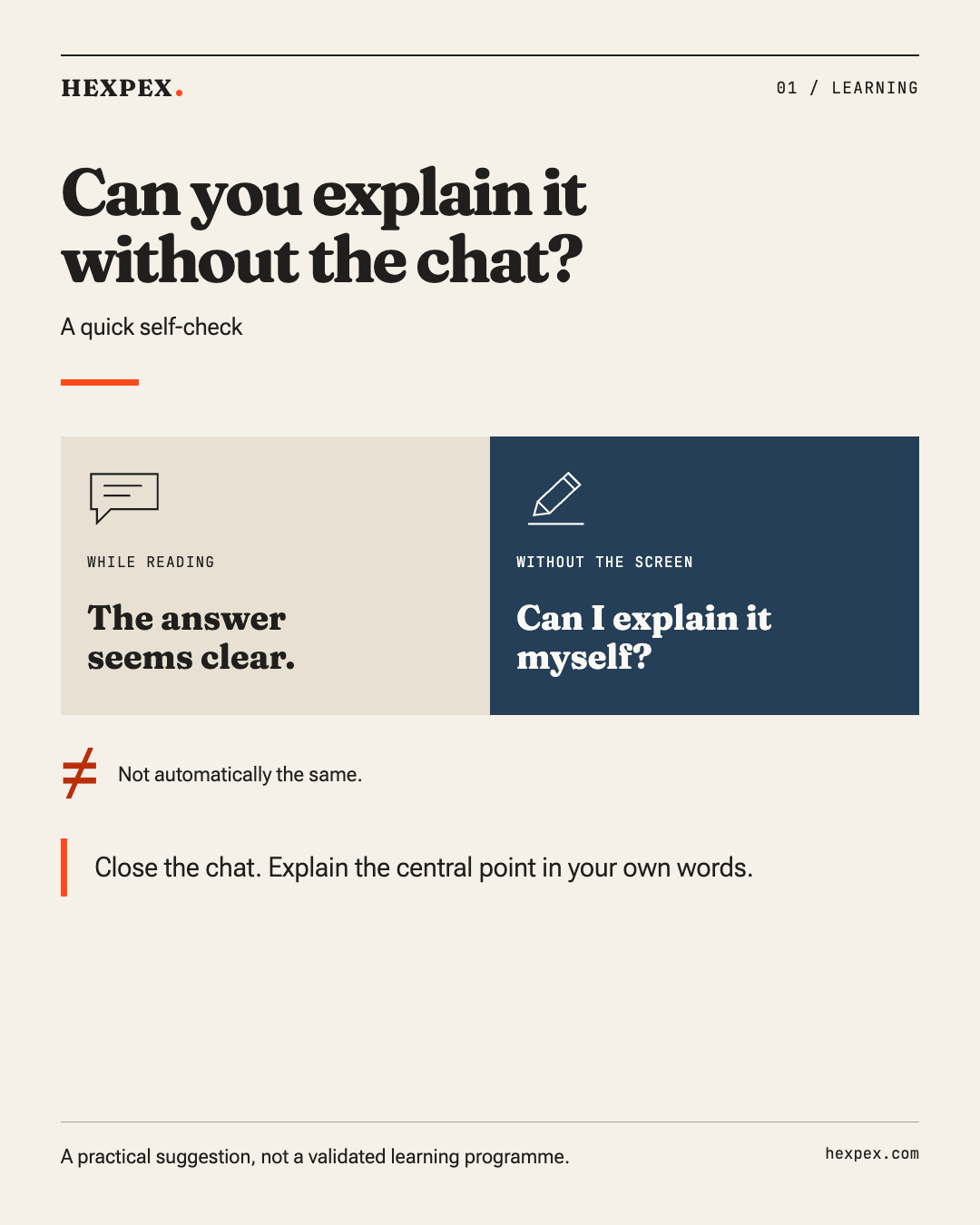
If you get stuck, ask for a hint first. Check the feedback against the learning material: a confident correction can still be wrong. At the end, close the chat and explain the central point in your own words. One manageable task is enough.
HEXPEX01 / Learning
Can you explain it
without the chat?
A quick self-check
While reading
The answer
seems clear.
Without the screen
Can I explain it
myself?
≠
Not automatically the same.
Close the chat. Explain the central point in your own words.
The rule remains your choice
A prompt is a request to the chatbot, not a reliable lock. If your next message asks for the answer, it may provide it. Even the rule in our learning template does not turn a chat into a validated tutoring system.
Set your own routine: write down an attempt, then ask for a hint. If the AI reveals the solution too quickly, start with a new problem. This is a practical suggestion, not a validated learning programme.

Which template fits your task?
For a quiz, use “Practise a learning text”. If you struggle to put an idea into words, try “Explain a topic yourself”. “Tell two concepts apart” helps with similar terms; “Practise a travel conversation” offers a short exchange in another language.
All four are in our new collection. These are editorially developed templates. We have not yet compared these new versions across several chatbots.
Sources
- Bastani et al. (2025), PNAS
Mathematics at one school in Turkey: AI-assisted practice followed by an unassisted test.
- Kestin et al. (2025), Scientific Reports
194 students, two physics lessons, a custom-built tutor and immediate learning outcomes.