Hands-on
Why “make it better” isn’t enough
You ask for a text to be improved. After the third revision it sounds different — but is it more useful to the reader?

What to ask for
“Better” leaves a lot open. Should a notice be shorter, friendlier or readable from two metres away? Without a yardstick, it is hard to judge a change. Another heading might help. Three extra paragraphs might hide the important information.
Take a notice for a film night. Guests need the time, the place and the right entrance. You could ask:
“Shorten this notice to no more than 40 words. Keep the time, place and entrance. Do not invent details. If any of these are missing, ask first. Give me one version. If the text already meets the criteria and is clear, say so; do not change it just to make a change.”
Then check the three details yourself. You could also show it to someone unfamiliar with the venue: could they find their way? That gives you a more concrete yardstick than a fourth, prettier version.
For a single revision like this, start with an ordinary chat. In its introductory article, Anthropic recommends the simplest solution that fits. Some tools described there are outdated, but the basic principle remains a useful starting point.
This template is our suggestion, not a proven recipe. A stopping instruction does not replace your own checks. It makes clear that “This already works” is an acceptable answer.
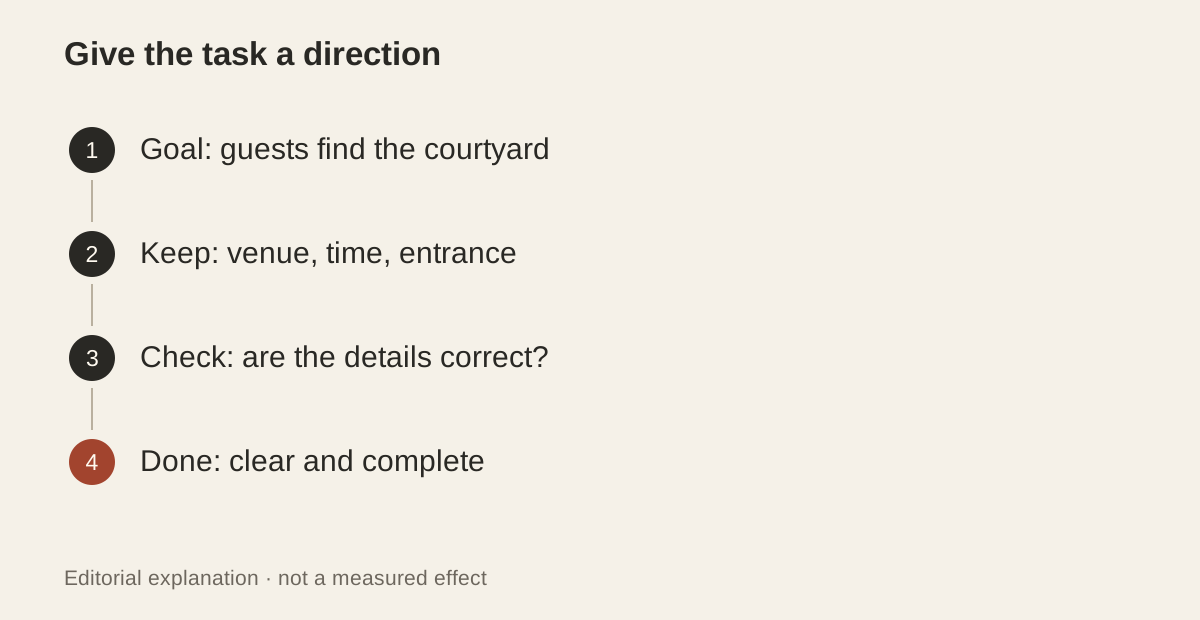
From a notice to useful directions
Text explanation
A film night is announced, but the entrance is missing. Directions to the passage on the left are added. Venue, time and entrance are then checked. This is an editorial example, not a product test.
Sources
- Anthropic · Building effective agents
Originalquelle; Stand 1.11.2026.